
When Does Advanced Imaging Add the Most Value to Your Research?
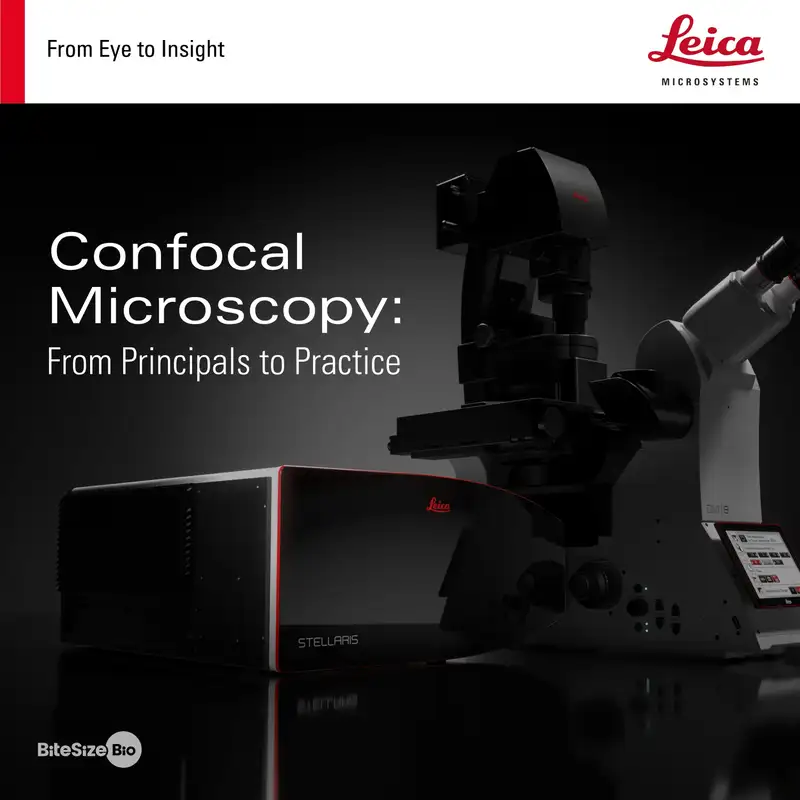
You're listening to Convocal Microscopy from Principles to Practice, a bite sized bio podcast produced in partnership with Leica Microsystems. Discover Science Lab, the knowledge portal of Leica Microsystems. The portal supports beginners, experienced practitioners and scientists alike in their everyday work and experiments. Explore interactive tutorials and application notes, Discover the basics of microscopy as well as high end technologies. There's a link in the show notes if you want to explore that.
Laura Grassie:In this series, we're breaking down how to choose the right confocal system for your research. Each episode tackles one part of the process so you can move from understanding to making a confident choice. In this episode, we'll look at how to decide which imaging capabilities you actually need. In the last episode, we explored what convocal microscopy can actually do. Multicolor imaging, live cell imaging, super resolution, fluorescence lifetime imaging, and more.
Laura Grassie:And if you're like most researchers, at least some of those probably sound useful, maybe even essential. But this is where things can start to go wrong because not all capabilities are equally important for every experiment. And in some cases, adding more capability can actually make your work more difficult. One of the most important ideas to keep in mind is this. Most advanced does not automatically mean more suitable.
Laura Grassie:In many cases, the best system is not the most complex one, but the one that most closely matches your experimental needs. So the question we're focusing on here is simple. Do you actually need advanced imaging? Because modern confocal systems are designed as platforms, they can support a wide range of techniques. But that does not mean you should use all of them or pay for all of them.
Laura Grassie:The goal is not to maximize capability. It is to match capability to your research. When we talk about advanced imaging, we're usually referring to techniques that go beyond stand or confocal imaging. Super resolution microscopy, fluorescence lifetime imaging, multi photon or deep tissue imaging, and advanced quantitative approaches. These techniques extend what you can observe, but they also introduce complexity.
Laura Grassie:And each one is designed to solve a specific type of problem. Let's start with super resolution. This allows you to go beyond the diffraction limit, the fundamental limit of light where structures closer than about 200 nanometers cannot be distinguished using conventional microscopy. In some areas of research, this is essential. For example, if you're studying protein localization at the nanoscale or the organization of molecular complexes.
Laura Grassie:In these cases, standard confocal simply does not provide enough resolution. But in many cases, it is not necessary because super resolution often requires more complex setup. More careful sample preparation and higher light exposure, which can increase phototoxicity and photo bleaching. It may also involve longer acquisition times. So while it provides more detail, it also changes how you work.
Laura Grassie:For example, if you are imaging fixed samples to steady fine structural organization, super resolution may add real value. But if you're working with live cells tracking dynamic processes, that additional resolution may not change your biological conclusion. It may simply make the experiment harder to run. This is where system design starts to matter. Some platforms allow you to switch between standard confocal and super resolution modes more easily, which means the technique becomes something you can actually use rather than something that is technically available but rarely practical.
Laura Grassie:Now let's look at fluorescence lifetime imaging or FLIM. Traditional fluorescence imaging measures intensity, how bright the signal is. FLIM measures something different, the time a fluorophore remains in an excited state before emitting light. The lifetime can change depending on the molecular environment, which means it can reveal information about molecular interactions and cellular conditions. So this is a different type of question, not just where something is, but what it is doing.
Laura Grassie:For example, if you are studying protein protein interactions, intensity alone may not tell you enough, but changes in fluorescence lifetime can reveal where the interactions are occurring. If your research depends on understanding molecular interactions or changes in cellular metabolism, FLIM can provide information that standard imaging cannot. But if your focus is structural, you may not need it at all. And, this is where integration matters. Techniques like FLIM are most useful when they are part of a broader imaging workflow rather than requiring a completely separate system or setup.
Laura Grassie:LEICA Microsystems' TauSense technology is a suite of imaging tools based on fluorescence lifetime that allows you to extract an additional layer of information from every sample, enhancing the scientific impact of your research. TauSense comprises application oriented imaging tools built on fluorescence lifetime measurements, enabling you to explore molecular function within the cellular context with few clicks. There's a link in the show notes if you want to explore that. Another advanced capability is deep tissue imaging, often achieved using multiphoton microscopy. This approach uses longer wavelengths of light, typically in the infrared range, which scatter less and penetrate deeper into biological tissue.
Laura Grassie:This allows imaging deeper into samples, sometimes up to around a millimeter. This becomes important if you're working with thick tissue sections, whole organisms, or complex structures like brain tissue. For example, in neuroscience where you may need to image deep into brain tissue, standard confocal may not provide sufficient penetration. In this case, multiphoton imaging becomes essential. But for thinner samples, such as cultured cells, this capability may not be necessary, and it introduces additional complexity, higher laser power, and more specialized system requirements.
Laura Grassie:Modern systems increasingly aim to integrate multiple techniques into a single platform, allowing you to move between applications without needing separate instruments. But this also increases complexity. More capabilities bring more configuration and more training. Every added feature introduces new variables into the workflow, increasing both flexibility and complexity. The result is greater experimental control, but also a greater need to balance performance, reproducibility, and ease of use.
Laura Grassie:This is why usability becomes critical. Systems that simplify setup, automate routine adjustments, and guide users through workflows make advanced techniques much more practical in real world use. So instead of asking what is the most advanced system available, ask a different question. What problem am I trying to solve? Because each advanced technique solves a specific problem.
Laura Grassie:Super resolution solves resolution limits. FLIM provides insight into molecular interactions. Multiphoton enables deep imaging. If you want a clear breakdown of how these techniques compare and when each one is actually useful, Leica's Confocal BioGuide summarizes their strengths and limitations in a structured way. There's a link in the show notes if you want to explore that.
Laura Grassie:One of the most common challenges in system selection is balancing what's possible with what's necessary. It's easy to choose based on maximum capability rather than everyday requirements. Advanced systems can offer impressive flexibility. But they can also introduce more complex workflows, additional training requirements, and features that may go underused. Thanks for listening.
Laura Grassie:If you want to go deeper, the guide accompanies this series includes figures, examples, and structured decision framework to help you apply what we've covered. The link is in the show notes. And in the next episode, we'll take the next step. We'll turn that into a practical framework for choosing a system.